Human ReadyProduct

Product

How Advisor works, end-to-end. The capabilities, the architecture, and the integration model.

Part oneCapabilities

Four capabilities, one platform.

Advisor combines a conversational interface for new questions with structured workflows for forecasting, optimization, and reporting. All four work against the same data, the same business knowledge, and the same audit trail.

Capability 01 · Ask

Ask any business question. Get a recommendation, not a report.

Enlarge

Type the question a board member asked, or the one your CFO raised in the ExCom. Advisor works through the analysis: data pulled, assumptions stated, scenarios compared. It returns a structured recommendation with its reasoning visible.

Every output is grounded in your actual data, with sources cited at every step. Ask isn't a chatbot stitched onto a dashboard. It's a reasoning interface that runs the same analytical engines used by Forecast, Optimize, and Report, with the natural-language layer on top.

What it handles

  • New questions that fall outside the planning cadence
  • Variance investigation across multiple dimensions
  • Cross-system queries that would normally require multiple analyst hand-offs
  • Slide-ready outputs with title, chart, insights, and recommendation in one response
Capability 02 · Forecast

Test a decision before you make it.

Enlarge

Change a price, a volume, a headcount, a capex assumption. See the impact across P&L, cash flow, and balance sheet, modeled against the same driver-tree decomposition your FP&A team would build manually.

Run three scenarios side by side. Save them, share them, return to them when the inputs change. The methodology is rule-based and transparent, so finance leadership can challenge any assumption and recalculate without rebuilding the model.

What it handles

  • Rolling forecasts with version control
  • Scenario modeling against interdependent assumptions
  • Driver-tree decomposition to operational variables
  • Variance bridges between forecast and actuals
Capability 03 · Optimize

Find the savings, sized and prioritized.

Enlarge

Advisor scans operations, spend, and contracts, then proposes specific actions ranked by financial impact. Each recommendation comes with a transparent business case: the data behind the savings estimate, the assumptions, the implementation difficulty, and the impact range.

You approve, adjust, or reject. The platform tracks initiative progress against the original case, so the savings story is auditable from identification through realization.

What it handles

  • Spend analytics with maverick spend and price leakage detection
  • Should-cost analysis with bill-of-materials modeling
  • Initiative pipeline with sizing, prioritization, and tracking
  • Category-level savings opportunity identification
Capability 04 · Report

Performance summaries that update themselves.

Enlarge

Variance bridges, narrative explanations, and performance summaries that pull from live data and update automatically. Templates are flexible. Outputs are pixel-perfect, slide-ready, and consistent across reporting cycles.

Your FP&A team stops assembling slides. They start advising the business.

What it handles

  • Automated month-end and quarter-end reporting
  • Variance explanations with root-cause attribution
  • Board-ready presentation outputs
  • Cross-entity consolidation with consistent definitions
Part twoHow it works

Built differently from the AI tools you've been pitched.

Most AI products in the enterprise space are LLM wrappers around dashboards. Advisor is built differently, because the work it does demands a different architecture.

Mechanic 01Architecture

Every AI product claims to be intelligent. Here's how Advisor actually works.

Advisor is not an LLM wrapper. It's a hybrid system where each output type has a specific composition, deterministic by design where precision matters and LLM-based only where interpretation helps.

The five formulas under the hood

ForecastsBusiness ModelsMarket Signals

A universal, structured way to represent business models with explicit drivers and constraints. Forecasts aren't statistical extrapolation; they're grounded in how your business actually works.

Market SignalsNarrativesBusiness Models

A methodology to generate quantitative market signals from LLM news digest narratives. External context that updates your models, not just your inbox.

AnswersTemplatesAnalyses

A syntax to represent business questions in your own vocabulary. An extensive library of analysis and answer templates, deterministically linked to each question. Every answer traces to a defined analytical path.

RecommendationsForecastsImpact Models

A curated knowledge base of business initiatives and deterministic analytics to estimate their impact on your specific context. Advisor doesn't guess what to do. It calculates.

ConversationsTemplatesLLM

LLM integration to build narratives and explain results, within the boundaries of the models and templates. The conversational experience of an AI, with the precision of an engine.

Deterministic engineLLM-based component
Mechanic 02Pre-loaded business knowledge

Arrives understanding financial models, cost structures, and industry benchmarks.

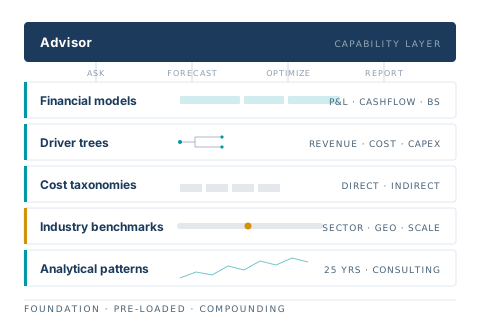
Advisor doesn't start from zero on each deployment. The platform comes with consulting-grade frameworks built in: financial models, driver trees, cost taxonomies, industry benchmarks, and analytical patterns drawn from twenty-five years of consulting work.

Your team doesn't spend six months teaching the tool how your business works. The knowledge is already there. Each engagement enriches it further, creating a compounding capability that no LLM-only product can replicate.

Knowledge base — layered schematic showing financial models, driver trees, cost taxonomies, industry benchmarks, and analytical patterns
Mechanic 03Integration and data

Sits above your stack. Doesn't replace it.

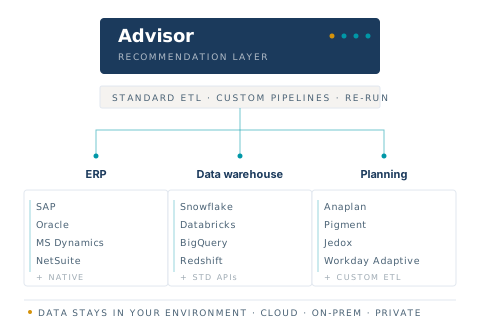
Advisor connects to ERP systems (SAP, Oracle, Microsoft Dynamics, NetSuite), data warehouses (Snowflake, Databricks, BigQuery), and planning tools. The platform pulls what it needs, transforms and unifies the data, and runs analysis without disrupting your existing systems.

Data stays in your environment by default. Standard integration APIs handle the common cases; custom ETL handles the edge cases. The platform's job is to make your existing systems useful for the decisions those systems weren't built to answer.

What's supported

  • Native connectors for major ERPs and data warehouses
  • Standard ETL pipeline with re-run capability for ongoing data refresh
  • Multi-entity, multi-currency, multi-language environments
  • Self-service ETL configuration on the roadmap
Integration topology — Advisor sits above ERPs, data warehouses, and planning tools
Mechanic 04Delivery model

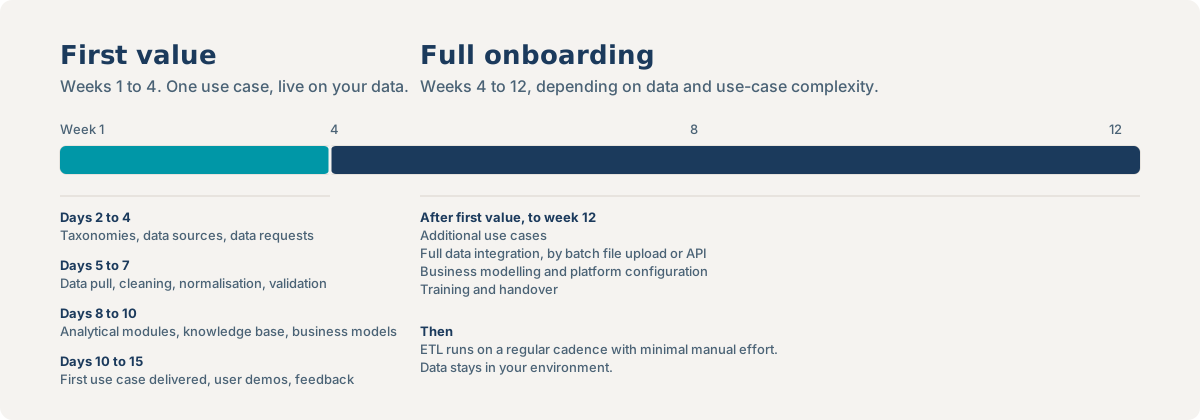
First results in weeks. Production in eight to fourteen.

A typical Advisor engagement takes eight to fourteen weeks to production. Clients see meaningful first results within the first few weeks, not at the end of a six-month implementation cycle.

  1. Days 2-4Align on taxonomies, identify data sources, build data requests
  2. Days 5-7Data pull, cleaning, normalization, categorization, validation
  3. Days 8-10Configure analytical modules, customize knowledge base, build business models
  4. Days 10-15MVP delivery, user demos, feedback collection
  5. Days 15+Refinements, additional use cases, training, handover

After initial setup, the ETL pipeline runs on a regular cadence with minimal manual effort. The long-term direction is fully self-service ingestion and configuration.

Delivery timeline — first results in weeks, production in eight to fourteen
Part threePositioning

What Advisor is not.

Buyers ask this question often, in different forms. Here are the four most common.

Not a BI tool

Advisor makes recommendations, not dashboards. BI gives you the instrument; Advisor gives you the reading. You stop asking “what does the data say” and start asking “what should we do.”

Not an LLM wrapper

Advisor is a hybrid system. Deterministic engines run the math. Language models narrate the results. The numbers are not the model's invention. Auditable by design, with no hallucination risk on quantitative outputs.

Not a consulting firm

Advisor embeds consulting-grade methodology permanently. The frameworks come pre-loaded; the analysis runs continuously; the capability stays after the project ends. You pay once for software, not twice for a recommendation.

Not an EPM replacement

Advisor sits alongside your existing planning tools, not in place of them. It adds the strategic and advisory layer that EPM tools weren't built to handle: new questions, novel scenarios, and recommendations grounded in your actual data.

Part fourTrust

Built for enterprise. Auditable by design.

The questions IT, security, and finance leadership ask before approving a deployment.

Auditability.Every number traces to source. Every assumption is editable. Every recommendation is logged with its reasoning. Outputs are reproducible and reviewable.

Data residency.Your data stays in your environment by default. Cloud deployment options are available; on-premise and private cloud are supported.

Security posture.Enterprise-grade authentication (SSO, SAML), role-based access control, audit logging, encryption at rest and in transit. Standard enterprise security review supported.

No hallucination risk.The hybrid architecture means language models never produce numbers directly. Every quantitative output is generated by deterministic engines and merely narrated by the LLM layer. The math is not the model's invention.

Engineering DNA.Built by the founding engineering team that built Feedzai, the platform that handles billions of transactions per year at major banks. Enterprise reliability is the baseline, not an aspiration.

05 — Common questions

Frequently asked

Which systems does Advisor connect to?

Advisor reads from the systems where enterprise data already lives. ERPs (SAP, Oracle, Dynamics, NetSuite, Unit4), planning platforms (Anaplan, Pigment, Jedox), data warehouses (Snowflake, Databricks, BigQuery), CRMs, and BI layers. It also ingests structured files and parses unstructured documents like invoices and POs. Connections are read-only by default, scoped by service account, and fully audited.

How is our financial data secured?

Each client runs on a dedicated instance. No multi-tenant data mixing, no cross-client sharing. Access is governed by role-based permissions via Keycloak, with single sign-on and full audit logging. Data is encrypted in transit and at rest. Architecture reviews with client security teams are part of every onboarding.

How fast does Advisor deliver value?

First usable output typically lands in two to four weeks. Production deployment runs eight to fourteen weeks end to end. The pace depends on data access and the depth of knowledge base configuration for the specific decisions Advisor will support. For reference, comparable Anaplan, Pigment, and Jedox implementations run six to sixteen months.

Does Advisor replace our FP&A or procurement team?

No. Advisor extends a high-functioning team, it doesn't replace one. It removes the mechanical work, pulling data, cleaning variances, drafting first-pass narratives, so analysts and managers spend more time on judgment, stakeholder dialogue, and decisions. The methodology behind Advisor comes from 25+ years of BCG procurement and FP&A work, encoded into the platform.

Is our data used to train models?

No. Customer data is never used to train foundation models. Each client's data stays inside their isolated tenant and is used only to answer that client's questions. Architecture and data flows are reviewed jointly with client security teams during onboarding.

How does Advisor avoid hallucinations?

Advisor is hybrid AI, not an LLM wrapped around your data. Deterministic engines handle math, forecasting, and value calculations. Machine learning handles pattern recognition. Language models operate inside a structured framework, never on raw data directly. Every output names its drivers, multipliers, and inputs. Every number traces back to source data. Designed for board-level and regulated-industry use.

Glossary

Concepts referenced on this page

Deeper definitions in methods.

AI advisor for FP&A
Software that combines a company's financial data with a structured knowledge base of FP&A methods to deliver forecasts, variance explanations, and recommendations as conversational outputs rather than static reports.
Variance explanation
The decomposition of the gap between planned and actual financial performance into driver-level causes — volume, price, mix, FX, timing — and the narrative that connects those drivers to operational decisions.
Driver tree
A structured decomposition of a financial outcome into its operational drivers, used to attribute changes in revenue, margin, or cost to specific business levers and to enable scenario modelling.
Cost optimization (FP&A)
The continuous identification of cost-reduction opportunities across categories — procurement spend, working capital, headcount, vendor contracts — supported by data, benchmarks, and structured analytical patterns.
Knowledge base (Advisor)
The layered repository Advisor draws on — financial models, driver trees, cost taxonomies, industry benchmarks, and analytical patterns — that lets it reason about a customer's data with FP&A and procurement expertise rather than as a generic LLM.

Schedule a working session.

Bring a decision you're trying to make, a use case you're trying to validate, or a stack you want to integrate against. Thirty to sixty minutes, structured around your specific situation, not a product tour.

See live deployments